
Client: The Royal Marsden NHS Foundation Trust – Sutton
Project Value: £1m
Refurbishment of an existing treatment suite that forms part of the major radiotherapy department completed 2005 and which Ansell & Bailey were the Architects and lead design consultant. The refurbishment includes the installation of linear accelerator (linac), new to the Trust and will form one of an operational pair, when the next treatment suite is refurbished. This new linac design is self-shielding, reducing the amount of scatter radiation whilst increasing the accuracy and efficacy of patient treatment.
The refurbishment provides for an improved workflow and increases safety along with patient privacy. Attention is paid to improving the patient experience with new forms of lighting that mimics overhead daylight, and the suite also has a more sensitive modulation of lighting levels and shades to ease patient preparation and promote a sense of wellbeing.
All the furniture and finishes have been upgraded to the latest standards and regulatory requirements. Attention being particularly paid to acoustic attenuation, of the equipment, and meeting Infection Prevention and Control guidance.
We are pleased to say that the feedback from the Trust has been very positive, and we look forward to embarking on the paired installation that will be the Beech treatment suite.


Client: Barts Health NHS Trust
Project Value: £6.8m
This project provided a new Community Diagnostic Centre, situated in the Ground Floor of Mile End Hospital. This is an outpatient facility offering a variety of diagnostic options in a single location. Combining different diagnostic specialties and cutting-edge equipment provides patients visiting the assurance of a single point of contact, a sense of familiarity and convenience. Mile End Hospital is well situated within it’s community with good transport links allowing visitors options and autonomy for their visit.
The location on the Ground Floor, only a short step from the main reception helps visitors to easily navigate their way to the diagnostic centre. Previously a ward, the interior was reconfigured to suit the new requirements, focusing on easily identifiable different diagnostic areas that worked holistically together to provide tailored facilities that are easy to navigate and created an attractive and calm environment.
Utilising an existing building, finding uses that better fit the needs of users and the community, is a sustainable approach to the built environment. This also reduces the new materials used, whilst improving the performance of the existing building fabric providing sustainable benefits in the long-term giving the space a new lease of life.
Staff experience in their working environment is paramount to the longevity and sustainability of healthcare projects. This project engaged fully with the staff to discuss the particular needs of each diagnostic team, what they wanted from shared facilities, so that the layout could be developed to meet all necessary adjacency requirements locate shared facilities within easy reach of all, but without compromising patient experience. Those specific areas for Staff are located away from the main routes, where they can truly recharge.


Client: Imperial College Healthcare NHS Trust
Project Value: £2m
This area was originally for medical records, then converted to serve as a vaccination centre. Located on the Ground Floor and accessed from the main hospital corridor this scheme provides a new outpatients facility with 10no. Consult/Exam Rooms; Treatment Room; Phlebotomy; Quiet Space; Staff Room and ancillary support spaces.
Designed to create a calm comfortable environment for Patients, Visitors and Staff with a clarity to the layout so it is simple to navigate, whilst ensuring the support spaces have the correct adjacencies for the most effective working environment.
Focusing on the feelings the design was to emote, evidence based design influenced colour and plant imagery choices, promoting calmness and wellbeing. Stakeholder engagement was integral to the decisions regarding the layout of the rooms, the choices of the plant imagery to be utilised, and colours. Focusing on patient experience, balancing use of different colours to enhance wayfinding and directionality with clarity. Hospital visits can be a stressful experience, efforts to avoid overwhelming patients with too much information were key to the design.
A commonality of a simple palette across all rooms links the area together, imagery echoed across spaces provide a simple connectivity for patients and visitors for navigation around the area. The plant and the corresponding colour are repeated from the stencils and totem in the corridors into the individual rooms reflected in the floor, imagery and furniture.
On entering the space, the openness and complementary colour scheme gives a sense of welcome and reassurance with spaces easily identifiable for the comfort of the users.


Client: Royal Marsden Hospital Chelsea
Project Value: £6m
Cavendish Square is a new research-led cancer diagnostics and treatment centre located in a beautiful Edwardian Grade II Listed building in Central London. The project is set over two floors, Ground and Lower Ground, with a plantroom area in the Basement.
In the Ground Floor, the Entry, Reception and Waiting room are located in the main Heritage area of the building, where the original features such as ceiling rosettes and fire places, have been restored and embraced to be the focal point of these rooms. The remainder of the Ground Floor offers a number of consultation rooms and chemotherapy treatment bays with all the necessary staff and patient support accommodation.
Home to a state-of-the-art diagnostic imaging suite, the Lower Ground Floor offers MRI, CT, X-Ray, ultrasound and mammography facilities, ensuring the Royal Marsden Private Care patients have access to the latest technology.
With special attention to detail, the facility has been designed with comfort, quality and excellence in mind. Its bespoke furniture and high-quality finishes help provide a contemporary feel that also embraces the original features of this fantastic historical building.


Client: Royal Free London NHS Foundation Trust
Project Value: £12m construction cost
Ansell and Bailey (A&B) were appointed to design the new Emergency Department (ED) and adjacent assessment unit for The Royal Free NHS Foundation Trust (RFL) while maintaining a live service throughout the works. Existing facilities within the site were inadequate and did not allow for the significantly increased number of patient flow expected over the next 10 years.
During the design stage, A&B visited a healthcare conference in the USA with the Trust and heads of the user working group. This visit provided valuable information on up and coming design practices within ED design, information which was directly transferable to the new RFL ED. Key points included improving patient flow with measures aimed at preventing the patient from ‘returning’ rather ‘moving forward‘ through the department. This idea of flow helped develop the use of chair centric or ‘waiting pods’ – individual smaller seated bays for patients awaiting results or requiring occasional monitoring, thus freeing up trolley bays for sicker patients. Design development also addressed the need to maintain the patients circadian rhythm by introducing light panels mimicking natural daylight and the ever increasing need to accommodate dementia patients with specific finishes to help improve the patient experience.
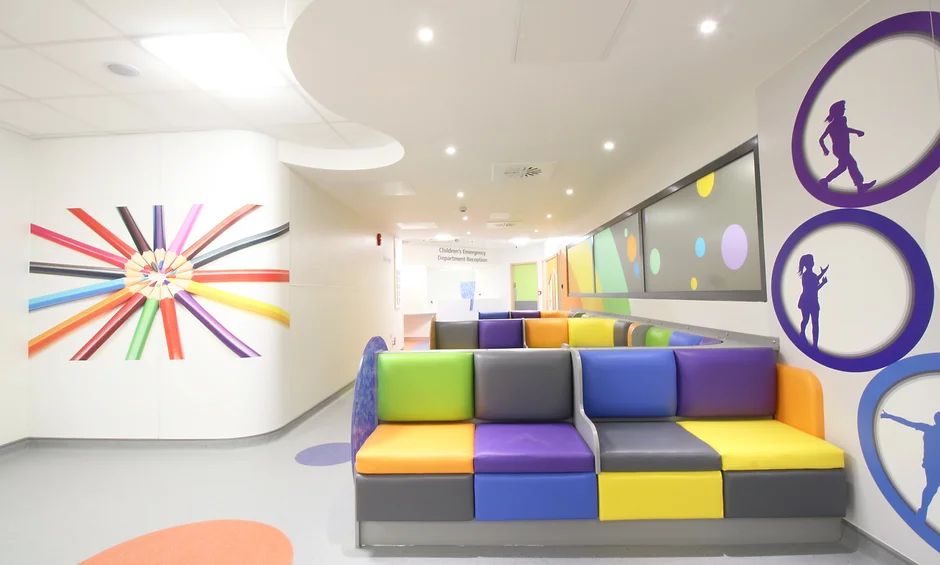
Contract 1 included the recently completed children’s ED with consulting rooms, four bed observation unit and separate isolation and mental health rooms:




Contract 1 also included a new six consulting room outpatient clinic associated with the ED, staff rest, changing and office facilities for the new department:


Contract 1 began with the creation of a new 24/7 out of hours entrance which included relocating security and the entire hospitals CCTV command centre:


| Cookie | Duration | Description |
|---|---|---|
| cookielawinfo-checkbox-analytics | 11 months | This cookie is set by GDPR Cookie Consent plugin. The cookie is used to store the user consent for the cookies in the category "Analytics". |
| cookielawinfo-checkbox-functional | 11 months | The cookie is set by GDPR cookie consent to record the user consent for the cookies in the category "Functional". |
| cookielawinfo-checkbox-necessary | 11 months | This cookie is set by GDPR Cookie Consent plugin. The cookies is used to store the user consent for the cookies in the category "Necessary". |
| cookielawinfo-checkbox-others | 11 months | This cookie is set by GDPR Cookie Consent plugin. The cookie is used to store the user consent for the cookies in the category "Other. |
| cookielawinfo-checkbox-performance | 11 months | This cookie is set by GDPR Cookie Consent plugin. The cookie is used to store the user consent for the cookies in the category "Performance". |
| viewed_cookie_policy | 11 months | The cookie is set by the GDPR Cookie Consent plugin and is used to store whether or not user has consented to the use of cookies. It does not store any personal data. |